
Memory & secret languages
Why a singular national identity is a form of suppression

Ever wondered why eating pork is a national obsession in Spain?
Okay, that sounds like a very random question. So, let me you ask this;
How does ‘national identity’ emerge?
What happens to collective memory when it is violently suppressed over generations?
What does state-sanctioned violence to do the memory of a people?
They are questions that resonate today.
And it’s not just a question for those living in the margins of society.
There are many people (particularly in Europe) who will say that the national identity they live with brings soft, fuzzy feelings. But national narratives always have a shadowy side. Be wary of them.
Let me take you (back) to the origins of this singular obsession that is rearing its head today, and why it matters today.
After seven centuries of Muslim presence in Spain, the new Catholics rulers in 1492 agreed in writing that they not interfere with the Spanish Muslim populations customs, habits and rituals. Within just seven years, they not only went back on their promise. They purposefully co-ordinated a ruthless campaign for mono-religious/cultural/political unity.
Very quickly, all Spanish Muslims were obliged to convert to Christianity or leave. Most chose to stay at home. Conditions to leave the country were also harsh to the extent that it forced people to stay.
Just 19 years after their original promise, the ruling Catholics, in their quest to make a nation without contradictions, banned Islamic-inspired clothing, music, dancing, food and language.
And then it started. In the second half of the 16th century, in Valencia, the order to burn Arabic language books (both secular and religious) started, and then spread.
In this universe of language bans and book burning, a secret language appears as a form of resistance.
Living with the pressure to comply with a total Arabic language ban, the community of secret Muslims, themselves pretending to be Christians in public, created Aljamiado.
Aljamiado was a smokescreen language, ‘Castilian nonetheless, dressed up, disguised as Arabic and written in the beautiful Arabic script that evoked something that was no longer real.’1 It looked like Arabic on paper, but wasn’t at all. When spoken, it was in fact Castilian, the only accepted language left in Catholic Spain.
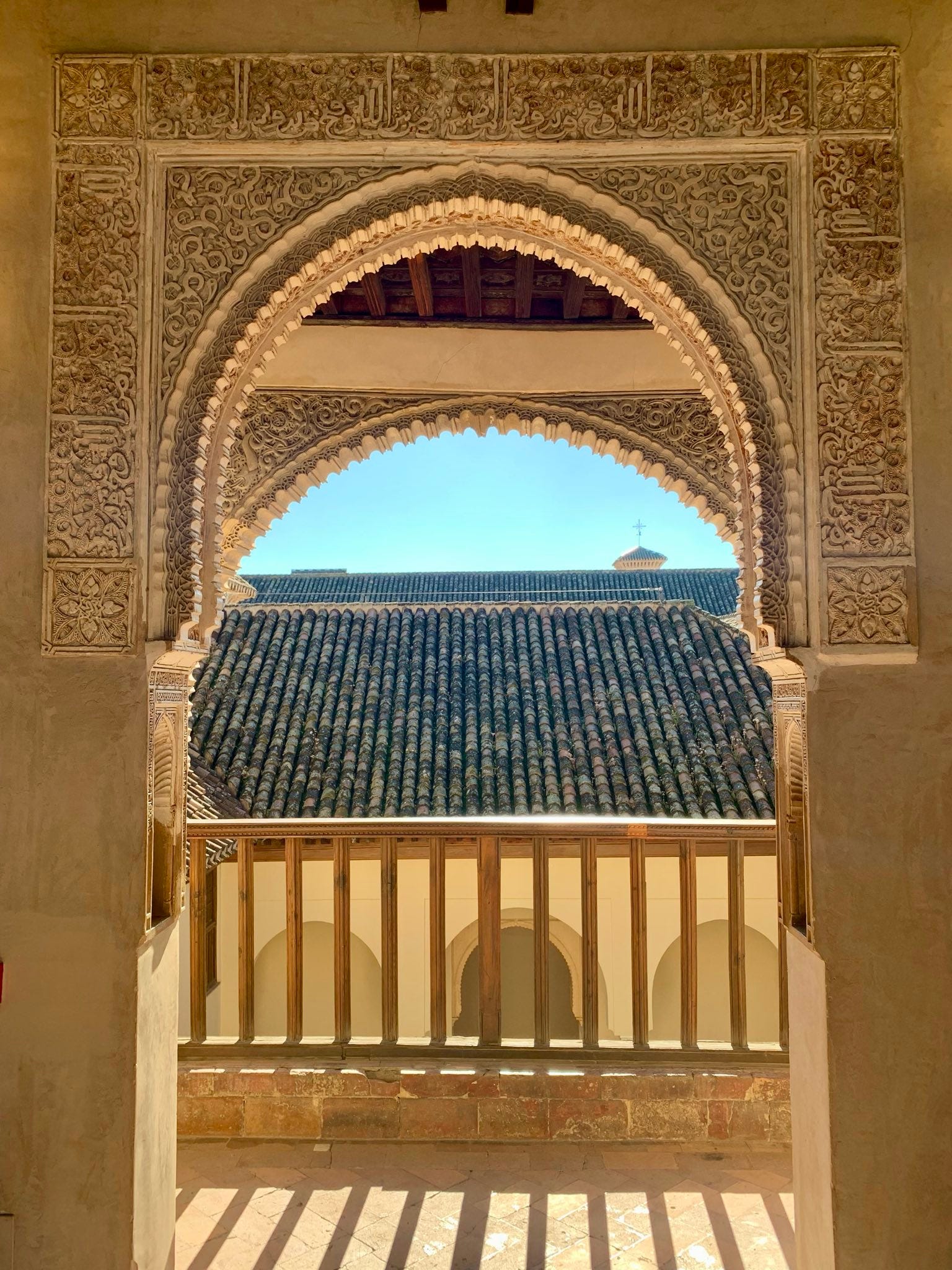
Just like the Arabic script painted in Spanish churches centuries beforehand, Aljamiado is another twist in the long history of multiple belongings in Iberia.
Except, while the former was a celebration of coexistence, Aljamiado was a linguistic trick to keep a dying memory alive. A form of protection for a people’s collective memory fast fading away as state-sanctioned violence literally burned books.
It is in these violent circumstances that the first modern novel appears and unwittingly preserves a dying memory.
You will find it inside Miguel Cervantes’ Don Quixote. (It’s a hefty book!). The novel is a ‘memory palace’ of old Spain, showing glimpses of that era before monolingual, monocultural nation states arrive. By the time Cervantes publishes the second part of his epic in 1615, Aljamiado is virtually extinguished in real life and only exists in his work of fiction.
To understand how collective memory can play tricks when surrounded by violence, and how a society that first cherished multiculturalism imploded, just take a look at this.
In Don Quixote, the fictional Morisco (a forcibly converted Muslim-turned-Christian, a term used for multiple generations) is asked to read a manuscript of a now extinct, but once loved, language. He laughs out loud when arriving at the story of a woman named Dulcinea, the “best hand at salting pork of any woman in La Mancha”.
This is where the tricks of rituals, performance and identity turn tragic.
The more conspicuously she did all those Christian things, the more likely she was merely pretending to be a Christian. Or, more insidiously, and in the end more tragically, that her parents or grandparents had pretended to be Christians, to survive. And she, well, who knows what she might be, after a while; after one generation, or after a century, or perhaps more, you forget why you lit those candles on Friday night so secretly.
She can’t remember whether eating all that salted pork is part of what she was supposed to be or what she was not supposed to be.2
Both Aljamiado, that secret language, and eating pork, that violent public ritual to prove one’s ‘Christianity’, became ways to survive. The secret language died off, never to be found again as a nation state erased the collective memory of a people, while pork became the epicentre of a ritualised trauma, twisted into the fabric of a national identity that remains to this day.
“Spanishness” and pork now seamlessly go hand-in-hand.
Aljamiado, long hidden from view, only resurfaced when secret books concealed inside walls by the Muslims hiding their crypto secret language, emerged during major housing constructions in the 19th century.
There is one, final irony to note. One final glimpse of that old world of multiple belongings.
The old, Castilian language Miguel de Cervantes wrote Don Quixote in was, in fact, a direct descendant of the Castilian first born from the groups of Muslims, Christians and Jews who worked together centuries before in Toledo, translating Arabic libraries into local European vernculars.
The story of sixteenth-century Spain is usually told as the story of a ‘mighty’ American empire. Or the arrival of a new modern literary genre that rivalled Shakespeare.
Yet, as both pork and hidden languages testify, it is also a hidden, tragic story of the forced extinction of the ‘other’ religious cultures that had once made up Spain.
The very place that had successfully pioneered a European society holding multiple belongings had, through over a century of state-mandated violence, bent itself in such as a way that it pioneered the modern Colonial way of thinking we find ourselves sitting in today.
National identity can never be one, smooth narrative.
Polished, singular narratives are insecure and fragile. Take a look behind the curtain and you’ll find the darkest of shadows.
Maria Rosa Menocal, The Ornament of the World, How Muslims, Jews and Christians created a culture of tolerance in Medieval Spain, p.260
Menocal, p.263